

Case Study: Ecommerce (Kauaʻi, Hawaii)
Direct-to-consumer ecommerce business selling organic noni-based products.
Engagement Snapshot
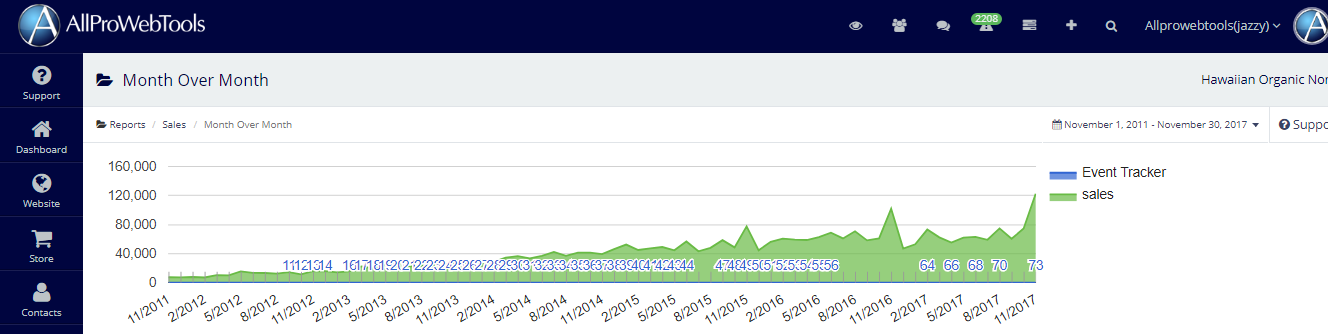
- Results: Increased monthly sales from $7k to $122k in 6 years
- Engagement Dates: 2011 to 2020
- Industry: Direct-to-consumer ecommerce (organic wellness products)
- Location: Kauaʻi, Hawaii
- Team: Soloprenuer

References Policy
My work with clients is confidential by default. Most engagements involve sensitive operational details, financial context, internal team dynamics, and customer data. I do not disclose client information, internal documents, or private communications unless the client has explicitly authorized it.Any public examples on this website are shared only to the extent a client has approved. In some cases, clients have given permission for limited disclosure such as photos together, a short written quote, or select clips from recorded coaching sessions. When those assets appear, they reflect client consent for that specific use only and do not imply broader permission to share additional details.If you are considering hiring me and would like references, I can provide them when appropriate, subject to client availability and confidentiality constraints. In all cases, I will protect client privacy and honor any restrictions requested by the client.Executive Summary
The company had a product with proven demand, but growth had plateaued because the website was outdated and hard to change and lacked modern customer tracking and promotion capabilities, and did not provide measurement to connect marketing activity to sales outcomes.
My work as Fractional COO focused on building a measurable operating system for growth: a modern website and commerce layer, a repeatable email and customer retention cadence, SEO and content systems designed for niche demand capture, and a reporting system to improve decision quality.
- Monthly online sales: $7,000 baseline (early 2011) to over $50,000 (by April 2015) to $103,587.50 (November 2016).
- Monthly sales peak: $122,000 (November 2017).
- Lead flow from niche SEO: 50 to 120+ leads per month.
- Email list size: 22,000 subscribers added from 2011 to 2017.
- Marketing budget: $800 per month scaled to $5,000 per month, with marketing spend never more than 10% of total revenue.
Starting Point: What Was Breaking
- Website platform and workflow were too inefficent to support fast iteration, with changes requiring direct HTML editing.
- SEO foundations were weak, including non-SEO-friendly URLs and insufficient content and ongoing updates to content.
- Page performance and compatibility issues created friction in the buying experience (load time and cross-browser behavior).
- Ecommerce tooling lacked customer accounts, lead storage, repeat-customer tracking, and coupons and promotions.
- Tracking and reporting were insufficient to tie marketing actions to revenue, limiting decision confidence and slowing growth.
- Owner workload was elevated because growth depended on manual effort instead of systems, automation, and delegable workflows.
Objectives for the Engagement
- Build a new website while keeping the existing site running to avoid revenue disruption.
- Increase conversion and order value using promotions, quantity discounts, and a smoother shopping flow.
- Create a repeatable lead capture and customer follow-up engine using newsletters, offers, and abandoned cart recovery.
- Build measurable acquisition channels (SEO, content, PPC) with tracking and reporting for monthly decision-making.
- Reduce owner workload by shifting execution into systems and workflows while maintaining visibility and control.
What I Changed: The Interventions
Operating Cadence and Accountability
- Established a schedule-driven marketing rhythm using newsletters and recurring coupon offers as repeatable operating levers.
- Implemented a parallel-build approach for the replacement website to protect cash flow, then used performance validation to justify switching.
- Shifted day-to-day tasks into systems (automation and repeatable workflows) while maintaining reporting visibility for decisions.
Financial Visibility and Decision Support
- Built reporting systems so marketing performance could be reviewed and adjusted rather than treated as guesswork.
- Applied budget discipline by scaling marketing spend from $800 per month to about $5,000 per month while keeping it below 10% of revenue.
- Created repeatable reporting signals across sales, customer retention offers, and marketing performance to improve prioritization and prune underperforming activity.
Sales Follow-Up and Pipeline Discipline
- Built lead capture workflows that converted anonymous traffic into contactable leads and enabled automated lifecycle follow-up.
- Implemented abandoned cart follow-up emails to recover otherwise lost orders.
- Expanded customer follow-up capacity by enabling a call center to process phone orders outside the prior 9am to 5pm Hawaii Standard Time window which was incompatible with Eastern Timezone customers.
Process, Tools, and Delivery Systems
- Redesigned the website to be easy to update, with improved navigation intended to keep visitors exploring and support ongoing publishing via a blog.
- Improved SEO foundations through URL structure, keyword research, backlinking, and content expansion.
- Upgraded the ecommerce layer to support customer accounts, repeat-customer tracking, coupons, quantity discounts, upsells, and reporting.
- Built niche-demand capture assets, including additional websites and landing pages focused on specific audiences and topics, linking back to the main store.
- Implemented PPC campaigns with tracking to identify what was working and reduce wasted ad spend.
- Improved customer education through website content and monthly newsletter.
KPIs and Outcomes
| Metric | Before | After | Change | Timeframe/Date Notes |
|---|---|---|---|---|
| Monthly online sales | $7,000 | $122,000 | +1,643% | Baseline at start (early 2011); level reported by November 2017 |
| SEO Lead flow | None | 120 leads/month | N/A | Lead flow range attributed to niche SEO approach |
| Email list size | None | 22,000 subscribers | N/A | Described as grown over about 5 years |
| Marketing budget | $800/month | $5,000/month | +525% | Scaled over several years; described as never more than 10% of total revenue |
| Daily Order Volume | Not provided | 314/day | N/A | November 2016 |
- Before
- $7,000
- After
- $122,000
- Change
- +1,643%
- Timeframe
- Baseline at start (early 2011); level reported by November 2017
- Before
- None
- After
- 120 leads/month
- Change
- N/A
- Timeframe
- Lead flow range attributed to niche SEO approach
- Before
- None
- After
- 22,000 subscribers
- Change
- N/A
- Timeframe
- Described as grown over about 5 years
- Before
- $800/month
- After
- $5,000/month
- Change
- +525%
- Timeframe
- Scaled over several years; described as never more than 10% of total revenue
- Before
- Not provided
- After
- 314/day
- Change
- N/A
- Timeframe
- November 2016
The redesigned site and upgraded commerce layer made tracking, offers, and lifecycle follow-up possible. Once those mechanics existed, the business could compound results through repeatable newsletters and promotions, SEO and content for qualified demand capture, and PPC spend governed by tracking and budget discipline.
Timeline of Key Moments
- January 2011 – Engagement began.
- June 2011 to June 2012 – Monthly online sales tripled.
- April 2015 – Monthly sales reached $50,000.
- November 2016 – Monthly sales reached $103,587.50
- November 2017 – Monthly sales peak reported at $122,000.
Why This Worked
The core shift was moving from a weak website and unmeasured marketing effort to a full service business operating system with visibility. A website without marketing and reporting and a commerce system that cannot track customers prevents retention. By modernizing the platform and adding measurement, the business could learn faster and make better decisions.
Follow-through became measurable. Lead capture, email cadence, abandoned cart recovery, and offer tracking turned marketing into a set of repeatable inputs and observable outputs. That made it possible to keep what worked, stop what did not, and scale ad spend appropriately.
Tribal knowledge was converted into systems. Customer education content, niche landing assets, and a structured offer calendar reduced reliance on one-off founder effort.
Decision quality improved through visibility. The marketing budget was reinforced by tying spend to tracked sales and treating marketing as part of cash-flow management.
Transferable Value
- Operational diagnostics that translate growth plateaus into specific, fixable system constraints.
- Design and installation of a measurable operating cadence for marketing, offers, and reporting.
- Ecommerce platform modernization that enables customer tracking, promotions, and lifecycle follow-up.
- KPI and reporting design that connects spend and effort to sales outcomes for better decisions.
- Email marketing systems that create an owned-audience engine (newsletters, offers, automated triggers).
- Lead capture and follow-up workflows, including abandoned cart recovery.
- SEO and content systems for niche demand capture, including supporting asset creation and linking strategy.
- PPC governance with tracking so campaigns can be pruned and budgets scaled with confidence.
- Customer education systems that reduce support load while improving conversion behavior.
- Capacity enablement decisions, including extending order coverage through a call center model.